Ho Tzu Nyen: The Critical Dictionary of Southeast Asia
Ho Tzu Nyen: The Critical Dictionary of Southeast Asia
by Isabel Van Bos,



Ho Tzu Nyen, P for Power, 2026 ongoing, single-channel HD video, found footage and AI generated footage, real-time algorithmic editing system
“Southeast Asia” does not exist, or so the Singaporean artist Ho Tzu Nyen (b. 1976) insists. Coined in 1943 by American military strategists and later embraced by Western economists as the future of the world economy, the term for Ho Tzu Nyen is nothing more than a geopolitical projection—one that maps the colonial ambitions of British, French, and Dutch powers.
His response is an antidote. A continuously growing lexicon, The Critical Dictionary of Southeast Asia (2012, ongoing), in which each letter of the Latin alphabet illuminates a concept, motif, or biography from the region. T is for Time, P for Power, O for Opium. That these entries bear English titles is telling: even the organizing principles are steeped in the Western linguistic tradition the work simultaneously interrogates.
Ho works primarily with film and video installation, carefully edited, hypnotic essay films that treat history as a spiral of rhizomatic connections, favoring feverish retelling over linear narrative. Singapore, a pragmatic hybrid built on “Asian values plus Western institutions,” is the logical point of departure for such an inquiry. It is from this position, neither fully Western nor fully Asian, that Ho questions the construction of geopolitical categories. BOZAR amplifies that tension. Designed by Victor Horta in 1929, the building is a monument of European cultural authority; the moment you walk in, you feel the weight of the architecture as a backdrop for an investigation into the architecture of power. At a moment when Western powers are once again openly speaking of dominance and spheres of influence (Marco Rubio received a standing ovation for doing so at the Munich Security Conference), Ho’s practice is no academic exercise but a political act.
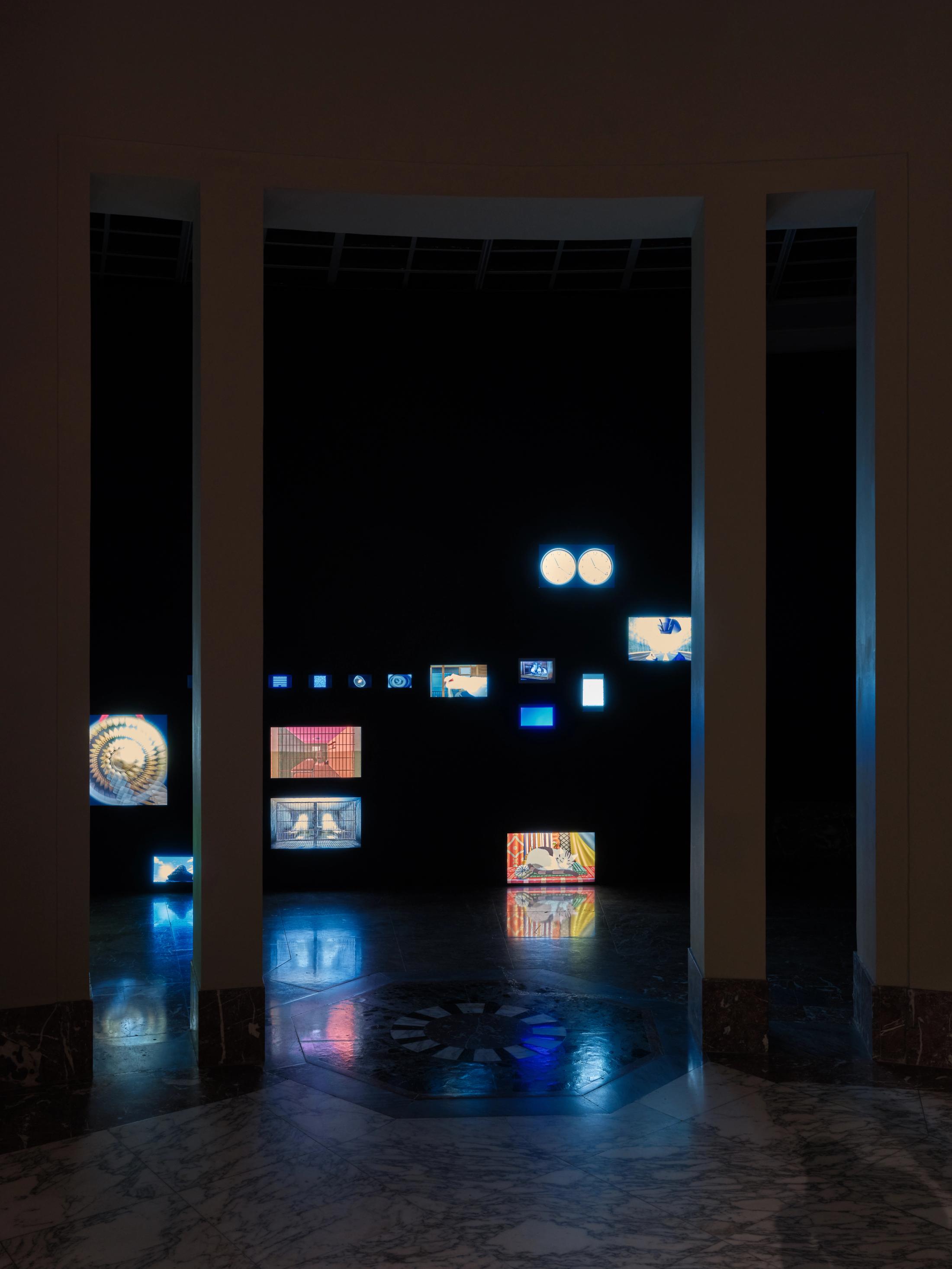
Ho Tzu Nyen: P for Power, BOZAR, Brussels | Photo: We Document Art
The capitalist clock of the West turns out to be just one of many possible rhythms
The capitalist clock of the West turns out to be just one of many possible rhythms

Photo: Stefan Khoo
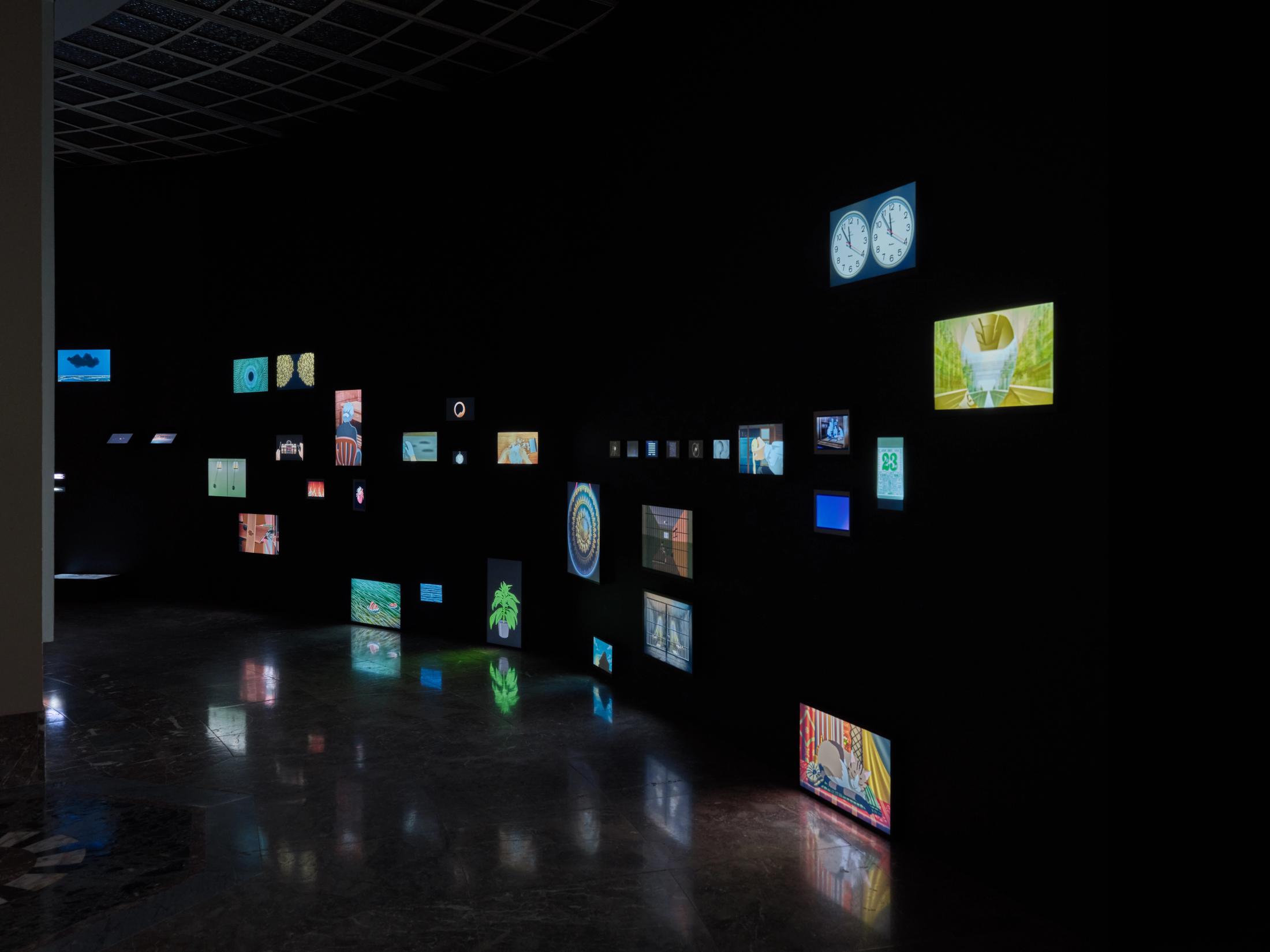
Time Pieces (2023, ongoing) is the first work you encounter. In a semicircular, darkened room, 43 screens of varying sizes form a constellation that immediately draws the eye. Cats in anime style, rotating planets, clouds, the Atomic Club, each screen plays something different, in cycles ranging from one second to twenty-four hours. Ho places popular visual culture alongside cosmic timescales and nuclear history to show how diverse and irreconcilable our concepts of time are. Linear, cyclical, sacred, time as perceived by animals, or the capitalist clock of the West is just one of many possible rhythms. The videos grip you: addictive but demanding. Ho relies heavily on prior knowledge, and the curatorial text becomes a necessary tool rather than a supplement.
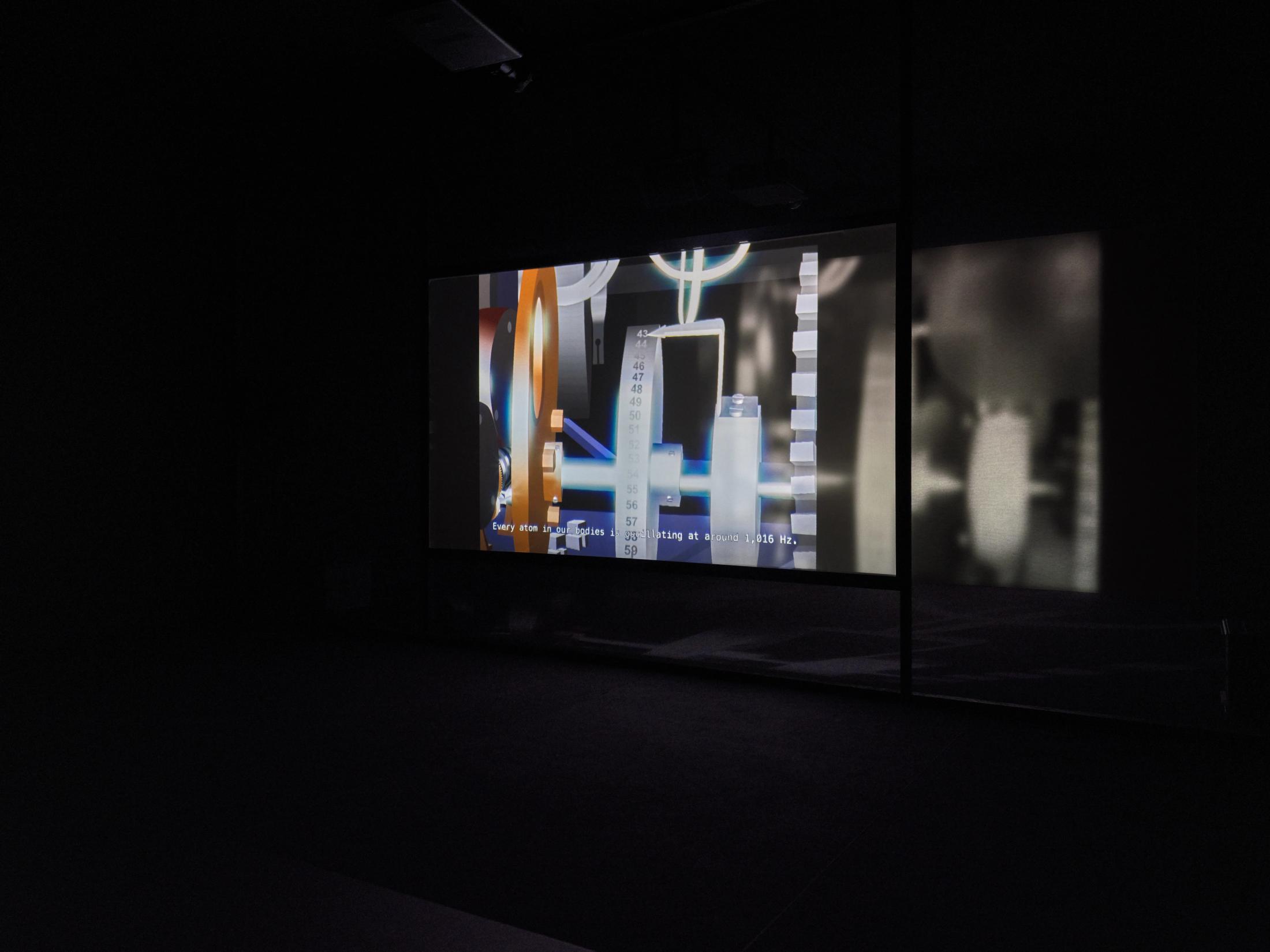
Installed across from Time Pieces, P for Power (2026, ongoing) plays out on a single large screen. Made especially for the exhibition at BOZAR,❶ the work consists of 30 real-time edited chapters built around a simple premise: a child’s voice, an AI chatbot, interrogating Ho about the nature of power. On screen, a theatrical video essay unfolds: found footage, animation, and AI-generated images in endlessly looping sequences. Van Gogh’s Pont de Langlois (1888) comes to life, gymnastic children suddenly sprout extra legs, an AI model replaces Leonardo DiCaprio in The Wolf of Wall Street with a South Asian child. The questions range across power in art, in religion, in nature, in politics, each chapter circling the same elusive concept. Inspired by Spinoza, Ho identifies a fundamental divide: for a Western observer, power is abstract, a delegation of authority; in many Eastern traditions, it is almost tangible, a concentrated energy entrusted to a strong leader. Yet each time the child demands a conclusion, Ho can only concede: “That’s unclear. And now go to bed.” No conclusion, only a reset.
Ho’s practice is philosophical at its core. His works invite not conclusion but shared inquiry. And sometimes the work buckles under the weight of its own ambitions, its dense web of references demanding more than most visitors are equipped to give. But maybe that is also precisely the point. The Critical Dictionary of Southeast Asia is, at its heart, a provocation: the suggestion that an alternative historical canon might be assembled, one that does not begin in the West and does not end there either. In a world where geopolitical categories are once again being redrawn by those with the power to end the conversation, an artist who refuses to accept those categories and who insists on building his own lexicon is more than welcome.
- ❶
Ho Tzu Nyen. P for Power, BOZAR, Brussels, February 6–June 14, 2026.

Ho Tzu Nyen: P for Power, BOZAR, Brussels | Photo: We Document Art

Ho Tzu Nyen: P for Power, BOZAR, Brussels | Photo: We Document Art
Ho Tzu Nyen, born 1976 in Singapore, is a visual artist and curator. He is the Artistic Director of the 16th Gwangju Biennale, which runs from September to November 2026. His current exhibition at BOZAR is on view through June 14, 2026.